

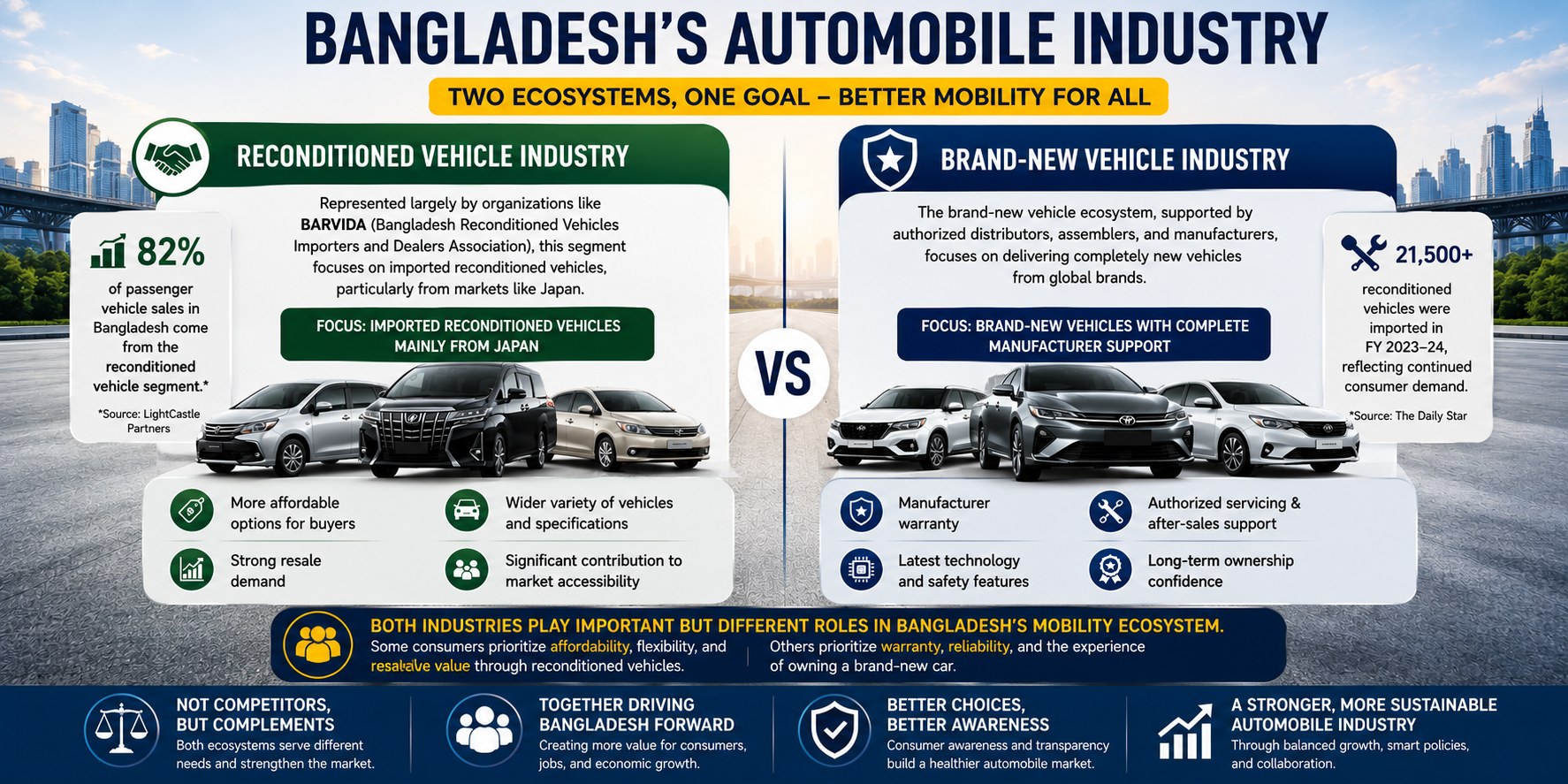
Bangladesh’s automobile industry is more diverse and dynamic than many people realize. While the sector is often discussed as a single market, in reality, it operates through two major ecosystems that serve different consumer needs and contribute to the country’s mobility landscape in distinct ways: the Reconditioned Vehicle Industry and the Brand-New Vehicle Industry.
As consumer demand evolves, taxation policies change, and hybrid technologies become more common, understanding these two ecosystems has become increasingly important for buyers, businesses, and policymakers alike.
The Reconditioned Vehicle Industry
One of the strongest pillars of Bangladesh’s automobile market is the reconditioned vehicle industry, represented largely by BARVIDA (Bangladesh Reconditioned Vehicles Importers and Dealers Association).
This sector focuses on imported reconditioned vehicles, particularly from markets like Japan, where consumers frequently upgrade vehicles and maintain high standards of quality and maintenance.
Historically, the reconditioned vehicle segment has played a major role in making vehicle ownership more accessible in Bangladesh. According to industry insights, approximately 82% of passenger vehicle sales in Bangladesh have come from the reconditioned vehicle segment, reflecting its strong contribution to mobility and affordability.
Why Reconditioned Vehicles Matter
There are several reasons why reconditioned vehicles remain highly popular in Bangladesh:
Affordability: Reconditioned vehicles are generally more budget-friendly compared to brand-new alternatives.
Variety of Options: Buyers often get access to a wider range of models, features, and specifications.
Strong Resale Value: The market for reconditioned vehicles maintains healthy resale demand.
Accessibility: This segment allows a larger portion of the population to access personal mobility.
For many consumers, especially middle-income buyers, reconditioned vehicles provide an ideal balance between affordability and functionality.
The Brand-New Vehicle Industry
On the other side of the market lies the brand-new vehicle industry, supported by authorized distributors, local assemblers, and international manufacturers.
This ecosystem focuses on delivering completely new vehicles from global automotive brands while offering structured support systems for ownership.
Unlike the reconditioned vehicle segment, brand-new vehicles are often positioned around reliability, official servicing, and advanced technology.
Key Advantages of Brand-New Vehicles
The brand-new vehicle ecosystem offers several important benefits:
Manufacturer Warranty: Buyers receive official manufacturer-backed warranty coverage.
Authorized Servicing: Dedicated after-sales support and service networks improve long-term maintenance.
Latest Technology & Safety Features: Access to modern innovations, fuel efficiency improvements, and advanced safety systems.
Ownership Confidence: Consumers benefit from a more structured and predictable ownership experience.
As Bangladesh moves toward greater adoption of hybrid and environmentally conscious vehicles, this segment is expected to continue expanding.
Not Competitors, But Complementary Ecosystems
A common misconception is that reconditioned vehicles and brand-new vehicles are direct competitors.
In reality, both industries serve different customer priorities.
Some consumers prioritize:
Affordability
Resale value
Feature-rich vehicles within a reasonable budget
Others prioritize:
Manufacturer warranty
Long-term reliability
New ownership experience
Official after-sales support
Rather than replacing one another, these ecosystems complement each other by serving different market segments.
The Future of Bangladesh’s Automobile Industry
Bangladesh’s automobile sector continues to evolve through:
Policy and taxation changes
Growth in hybrid vehicle demand
Consumer awareness and digital access to information
Expanding automotive financing options
Greater emphasis on sustainability
The future of mobility in Bangladesh may not depend on choosing between reconditioned and brand-new vehicles. Instead, it may depend on creating a balanced ecosystem that encourages affordability, innovation, transparency, and consumer confidence.
Both industries have an important role to play in strengthening mobility, economic activity, and the overall development of Bangladesh’s transportation ecosystem.
Final Thoughts
Bangladesh’s automobile industry is not a one-size-fits-all market.
The reconditioned vehicle industry, represented by organizations like BARVIDA, continues to support affordability and accessibility, while the brand-new vehicle ecosystem drives innovation, structured ownership, and technological advancement.
Different ecosystems. Different strengths. One shared goal:
Better mobility for Bangladesh.